YL AUTOMOBILE · FULL-CHAIN VEHICLE EXPORT SERVICE A Promise Delivered
How YL Automobile took fifteen vehicles from China to Burkina Faso — through four containers, three trucks, two border crossings, and every obstacle in between
|
15 Vehicles |
4 Containers |
3 Trucks |
2 Border Crossings |
1 Team |
|
Fleet |
Ocean Freight |
Overland |
PAGA & DAKOLA |
YL Automobile |
www.ylauto.com
October 2026 · Company Blog
When a B2B client from Burkina Faso signed a contract with YL Automobile (www.ylauto.com) for fifteen vehicles, the agreement was simple on paper: fifteen cars, sourced in China, delivered to his warehouse. In international trade, a signed contract is a promise. This is the story of how we kept that promise — and what keeping it actually took.
This is also the clearest answer to the question we hear most often: what exactly does YL Automobile do? We are not a freight forwarder. We are not a trading middleman. We are a full-chain vehicle export partner — one team responsible for the entire journey, from a dealership in China to a warehouse in West Africa. Whatever happens along the way, the responsibility stays with us.

Step One: Sourcing and Paperwork in China
Every export begins long before a container is stuffed. Working closely with the client, our team in China selected fifteen vehicles to match his business needs — including BYD Yuan Plus, BYD Seagull, and GAC AION models, chosen for their reliability, running costs, and suitability for the West African market.
The client planned to operate the vehicles under his own brand, so each car was prepared with his logo and signature yellow-and-orange livery before shipment. The fleet would not just be transportation; it would be a rolling advertisement on the streets of Burkina Faso.

Step Two: Inland Transport and Container Loading
Fifteen cars do not drive themselves to the port. We arranged car-carrier trucks to move the fleet to the port of loading, where the vehicles were professionally loaded into four containers — three cars per level, two levels per container, with steel frames, lashing straps, and protective foam wrapping to keep every vehicle secure through weeks at sea.

Car carriers moving the fifteen vehicles at night, heading for the port of loading.

Attention to detail: foam protection and bracing on every unit.
The containers were loaded onto a container ship bound for Tema, Ghana — the main maritime gateway for the region and the western terminus of the overland corridor to the Sahel.
Step Three: Tema Port — Unloading the Way the Client Wanted
When the vessel arrived at Tema, the conventional approach would have been simple: forward the sealed containers inland and let the client deal with devanning at destination. It is cheaper. It is easier. It is what most forwarders do.
But the client wanted something different. The cars carried his company logo, and he wanted them on the roads as moving billboards as soon as possible. Unloading the vehicles at Tema and transporting them on car carriers — rather than moving the containers themselves — costs more. We did it anyway, because serving the client’s goals is the whole point of the job.
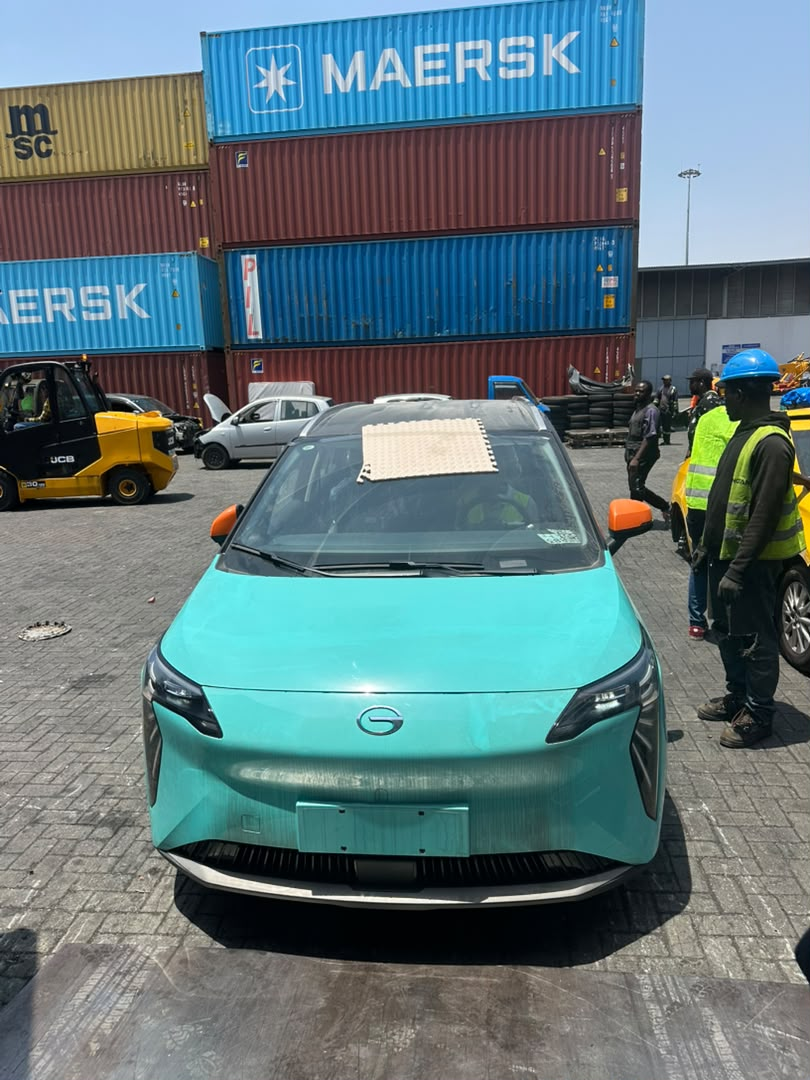
Our team cleared the containers through Tema port procedures, hired forklifts, and carefully lifted each vehicle out of the containers and onto our own car-carrier trucks.

Arrival at Tema Port, Ghana — containers cleared and ready for devanning.

Vehicles come out of the containers at Tema, ready for the road.
Working at the port also meant working with Ghana’s customs authorities. Given the size of the shipment, the local customs office assigned an officer to accompany the convoy for its entire journey through Ghana — a service we acknowledged and compensated properly, covering the officer’s travel expenses. With an official escort on board, the three trucks rolled out of Tema together, fifteen vehicles between them.

Forklift operation at Tema: every lift supervised and controlled.
Step Four: The Road North — Where the Real Test Begins
Anyone who has driven from the Ghanaian coast toward the Sahel knows the roads: long stretches of asphalt that give way to potholes, dust, and the occasional herd of cattle. Over the course of the journey, our convoy blew three tires. Each time, the drivers stopped, bought new tires from local roadside shops, refueled, and kept moving. This is what overland logistics in West Africa actually looks like — and it is why having a partner with real on-the-ground experience matters more than any price list.

Step Five: The Costs No One Puts in a Quotation
Here is a part of the story that rarely appears in any brochure. Along this corridor, beyond the official duties and fees printed on paper, every link of the journey tends to come with unofficial add-ons: a fee here, a “processing charge” there, an expectation at every checkpoint, every office, every handover. It is an open secret of doing business in the region, and no experienced operator budgets for it optimistically.
Some companies deal with this by renegotiating the contract midway, or by quietly passing these costs to the client. That was never an option for us. Every unplanned payment — the informal fees, the extra logistics, the tire replacements, the escort’s expenses — was absorbed by YL Automobile. The price we had quoted was the price the client paid. Not one dollar more.
We made that choice deliberately. A quote, to us, is not an opening position; it is a commitment. If the environment turns out harder than expected, that is our problem to solve, not our client’s burden to carry.
Step Six: Two Borders, Three Days, Zero Problems Found
At the PAGA border crossing on the Ghana side, our team handled the export formalities: customs declarations, vehicle inspections, and exit processing. At DAKOLA on the Burkina Faso side, we managed the import and transloading procedures, presenting the full document package we had prepared back in China — bills of lading, invoices, packing lists, and ownership documents, all consistent, all in order.
Even so, the shipment was held for a full inspection. For three entire days, customs officers examined the trucks and the vehicles. We cooperated fully and waited.
In the end, they found exactly what we knew they would find: nothing. All paperwork was in order, all duties properly declared, all fifteen vehicles exactly as documented. The convoy was released and continued to the client’s warehouse, where all fifteen cars arrived safely, on their own wheels, with the client’s branding intact.

Fifteen vehicles loaded on three carriers at the border transit

The convoy on the border corridor between Ghana and Burkina Faso.
A Promise Is a Promise
Let us be honest about the arithmetic. Between the port charges, the extended escort, the tires, the three days of standby at the border, and the long list of informal payments along the corridor, the margin we had planned on this order did not survive the journey. This was, in plain terms, an order delivered at a loss.
We would make the same choice again. A promise kept is worth more than a margin protected. The client received his fleet exactly as contracted, exactly when he needed it, without a single request for extra payment — and that outcome is the best advertisement YL Automobile will ever have. His verdict? Fully satisfied. He is already planning the next batch, as part of a 21-vehicle program with more units on the way.
Why This Delivery Matters
Fifteen cars is not the largest shipment in the vehicle export business. But the route — China to Tema by sea, then Tema through PAGA and DAKOLA to Burkina Faso by road — is one of the most demanding corridors in West African trade, and it tests every link of the chain:
l Sourcing and quality control in China, with vehicles matched to real market needs;
l Export documentation done right the first time, consistent across three countries;
l Ocean freight and port handling, including custom devanning at Tema;
l Overland transport with contingency built in — spare tires, fuel stops, and an official customs escort;
l Border formalities at PAGA and DAKOLA, handled face-to-face by people who know the process;
l Every unplanned cost absorbed by us, so the client never had to worry about a single one.

BYD vehicles at Tema before the northbound journey.
What YL Automobile Does — In One Sentence
YL Automobile is a China-based full-chain vehicle export partner: we source the vehicles, complete the export formalities, ship them, clear them, and deliver them to your warehouse — anywhere in Africa — under one responsible team, one transparent price, and one promise we always keep.
Whether you need five vehicles or fifty, new-energy or combustion, CIF to a port or DDP to your doorstep, we handle the entire chain so you can focus on your business.
Visit www.ylauto.com to start the conversation. Your fleet’s journey from China to your door begins with a single message.
YL Automobile — Driving Africa’s Mobility, Delivered from China. | www.ylauto.com
If you are interested in the content of the article, please do not hesitate to contact us for more vehicle related information:YL Automobile

Related Reading:
Chery Tiggo 5x—A Chinese car’sMarvel!
2026 SAIC MG5 Price and Review!
About the Author